8 min read
Holistic Reconciliation is Rooted in Caring for Creation
4/2/2026


OBEDIENCE. STEWARDSHIP. CREATION. HARVEST. DOMINION.
What are your first thoughts and emotions stirred up by these words? Depending on where you are from, your reaction to them can be quite nuanced and will differ as much as our upbringing.
How was nature, or what I will refer to as Creation, viewed in your culture? My mom grew up in the Philippines and it was the cultural norm to see nature as dangerous and connected to pagan worship. This is completely different from how I grew up with Creation.
I wonder what your relationship with Creation is and how your culture has shaped that? No matter what cultural background you come from, God’s Word calls you to care for Creation. This points to how God has knit reconciliation into all acts of obedience and care — as your obedience glorifies God and cares for others and yourself.
OUR RESPONSIBILITY
As with any topic, we as Christians get the beautiful responsibility to see what the Bible says about it. A biblical view of creation care requires cutting through some aspects of culture while celebrating the other aspects of culture that promote a biblical worldview.
What is your background with creation? What did your parents, grandparents, culture or even religious background impress on you about your relationship with creation? We have to look back and identify what cultural lens we were given in order to properly align it with Scripture.
When we study the Bible for how we are to interact with Creation (all of what God has made) we find a cohesive message: that God is Creator and cares for all His creation, not just His Image Bearers. But let's lean into two scriptures, Genesis 1:28 and Mark 12:29-31, to help shape our biblical view.
In Genesis we see the very first command given, to be fruitful and multiply; to fill the earth and subdue it, to rule over all other creations (paraphased). We are to rule over God’s beautiful creation in His place as His Image-Bearers.
In this role we are to spread His love, kindness, gentleness and compassion to all He created. It is not for us to use up, pollute and ignore; for is that how God cares for us? This means we have a responsibility to think about how we steward the limited resources God has given this world.
We must ask ourselves: Is the way I consume benefitting or hurting creation? Do I use restorative food practices or is my consumption draining resources?
If we understand that this is what God called and created us to do from the beginning then caring for His creation is an act of obedience.
CHOOSING OUR NEIGHBORS OVER CONVENIENCE
In Mark chapter 12 Jesus says, “Love the Lord your God with all your heart and with all your soul and with all your mind and with all your strength.’ 31 The second is this: ‘Love your neighbor as yourself.’ There is no commandment greater than these.”
Now what’s amazing is, if we follow through and obey this first command of caring for Creation, then we are also obeying what Jesus says are the most important commands: to love God and our neighbor. By obeying God and caring for creation as He would, then we are loving Him with our heart (desiring to honor the one we love), soul (understanding it is an act of obedience), mind (acknowledging we are stewards to His creation) and strength (it will take effort to obey and tend to His creation).
By caring for Creation through practices such as protecting waterways, composting, planting native plants, reducing water and energy consumption, reusing materials, buying produce and meat from regenerative farms, not investing in quick fashion, reducing single use plastics, using all your groceries, etc. we are actually loving our neighbors in tangible ways.
When we can shift our mindset from ‘what is the most convenient/cheapest for me’ to ‘how will this affect my neighbors’ we are seeking to love our neighbors more than ourselves. This mindset shift has been one of the most effective tools for me to love cross-culturally.
This is a hard shift because the ‘neighbors’ here are those we cannot see, they are the marginalized, the poor, those already living off a broken and barren earth. Our neighbors are the ones who see the devastating effects of wasteful consumerism because it washes up on their waterways, it takes away their forests, it washes away their soil.
While I can get into all of these details in this intro blog, Sandra Ritcher’s book, Stewards of Eden, clearly lays out how the marginalized (our neighbors) are the most at risk to environmental degradation. It makes it plain that sick land produces sick people and that our everyday decisions have power to either heal the land and therefore the people or cause more sickness to spread. How we choose to live on one side of the earth will have generational impacts on our neighbors locally and globally.
SMALL ACTS OF OBEDIENCE, LASTING IMPACT
Caring for Creation is a huge undertaking and can feel unsurmountable but let’s remember that this is a command God has given us, but He does not leave us unequipped. God gave us the Holy Spirit to guide us in understanding and living out His will on earth, helping us in times of need and showing us how to live a life fully surrendered to Him. This is an essential difference between Christians caring for Creation and non-believers who live an environmentally-friendly lifestyle.
My first recommendation is to seek the Holy Spirit through prayer and ask how you can steward God’s creation focusing on one area of your life: food, energy, eliminating single use plastics, etc. This mindset shift is not something that will be ‘finished’ in a month or even a year, so start small and gradually you will start to see how your changes can make big impacts in your community.
Here in Charleston, SC I always recommend people to get into composting. Composting is a great place to start because (1) everyone produces food waste—regardless of background, housing, or income—and (2) in Charleston, there’s a free municipal composting facility that processes organic waste. There are also many composting options, so even those in small apartments can participate. If food waste ends up in the landfill instead it does not have the right conditions to break down into compost, rather it decomposes and releases harmful greenhouse gases. But thanks to God’s beautiful restoration design straight from the Garden of Eden, when we compost properly, we put in dead food waste and get out a nutrient dense soil amendment that brings about new plant life.
When we ask to see God in all things, He gives us eyes to see His character revealed throughout all of His Creation, even in food waste. I love talking about composting with Christians because this formula of dead to life is exactly what the gospel says! Jesus died for our sins yet through God’s perfect plan, He was brought back to life to bring everlasting life to those who believe! What a remarkable reminder we have in composting food waste: how something that is dead can be used in God’s perfect plan to bring new life to those that use it.
So then is there a right way to view how we interact with Creation? Yes, thankfully as Christians the Bible shows us the reconciled way to view it!
Caring for Creation reconciles our broken relationships:
- with God by showing our reverence for Him in obedience and stewarding what He has given us
- with others, because how we steward our resources has a direct impact on our neighbor
- with ourselves, caring for creation is a humbling practice as it causes us to sacrifice daily so others may have a better life
- with the rest of Creation, as caring for it helps Creation thrive and fulfill its divine destiny, to display the wonders of our Sovereign King (Romans 1:20).
If we care for Creation in a God-honoring way, we are obeying God’s command to care for His Creation and in doing so we are loving Him, all of our neighbors, and all of life that yearn for us to steward them well until Jesus comes again and perfectly restores all of Eden.
Follow along
- Subscribe to the podcast on YouTube, Spotify, and Apple.
- Sign up to stay connected to future blogs, tools, and initiatives.
- Share this article with leaders and people of influence who are ready to grow.
Caring for Creation may feel overwhelming, but God equips us to obey. Begin by asking, “How can I care for my neighbor?” to guide your steps.
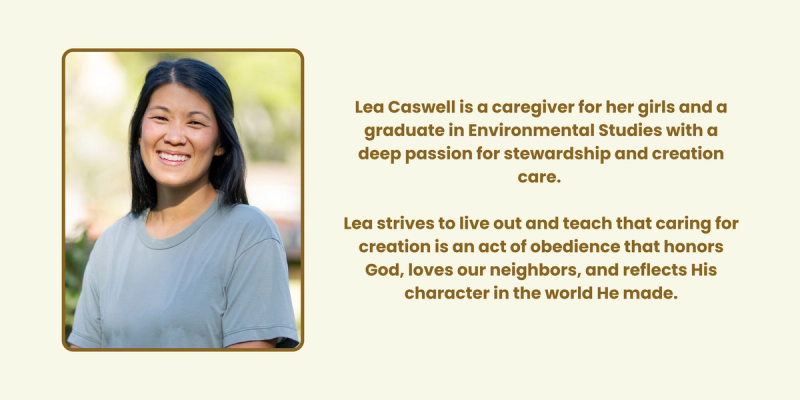
Blog by: Lea Caswell