5 min read
What Is Cultural Quotient (CQ) — And Why No One Ever Taught Us We Needed It
2/26/2026


WE PREPARED FOR THE TESTS, NOT FOR THE PEOPLE
Most of us spent over a decade preparing for academic success. We learned how to pass exams, write papers, and solve equations.
Many of us later learned how to manage emotions — how to communicate better, lead with empathy, and build healthy relationships. Emotional intelligence became part of the conversation, and for good reason.
But almost none of us were ever trained to navigate cultural differences.
And that’s strange… when our schools, churches, neighborhoods, and workplaces are more diverse than ever.
So we keep running into tension, misunderstanding, and division — not always because people are hateful, but because they are untrained. Untrained in reading context.Untrained in interpreting behavior. Untrained in understanding that what feels “normal” to us may feel foreign to someone else.
We prepared for tests. But not for people.
And that gap is costing us more than we realize
THE MISSING THIRD INTELLEGENCE
For years, we’ve talked about two kinds of intelligence.
IQ helps us think. EQ helps us relate.
But there’s a third kind that often goes unnamed, even though it shapes our daily lives:
CQ — Cultural Quotient.
CQ is the ability to function, communicate, and build trust with people whose backgrounds, values, and experiences are different from your own.
It’s not about being “politically correct.” It’s not about memorizing cultural facts. It’s about learning how to interpret behavior without rushing to judgment — and how to adapt without losing yourself.
At the CQ initiative we talk about this as cultural fluency. In the same way we can learn language to communicate to different people, we can grow in cultural competency to better work and worship with people from different backgrounds.
Just like emotional intelligence had to be named before people could grow in it, cultural intelligence must be recognized as a skill, not a personality trait.
Some people grow up around differences and develop CQ intuitively. While others become polarized to the same diverse spaces.
But either way, CQ is learnable. And in a connected, divided, beautifully complex world — it’s no longer optional.
THE ICEBERG BENEATH THE WATER
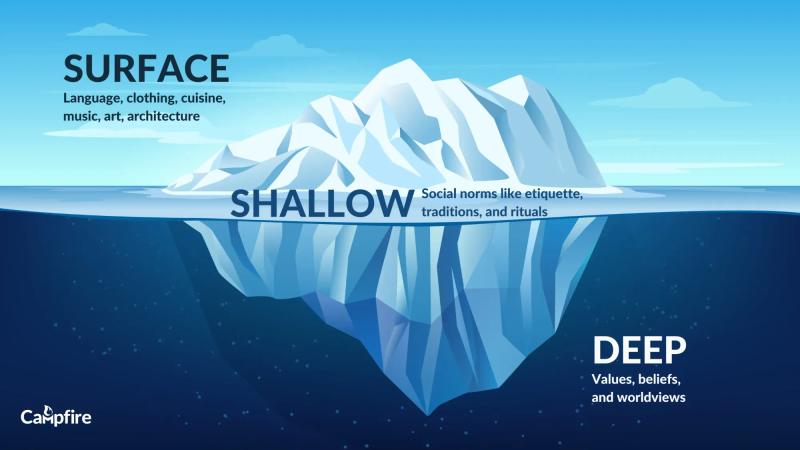
One of the most helpful ways to understand culture is the iceberg metaphor. It divides culture into two categories: material and immaterial.
Material culture is what we can observe - food, clothing, music, language, holidays, traditions, etc.
Immaterial culture is non observable - values, beliefs, communications styles, ideas of fairness, loyalty, and responsibility.
Our misunderstanding of other cultures don't come from the physical or visible things but are the values or beliefs that are hidden at first sight.
You notice what someone eats, wears, or celebrates in their own culture. But it takes time, humility, and intentionality to understand how they make decisions… How they define respect… How they respond to conflict… What they consider trustworthy.
CQ trains us to slow down long enough to ask better questions.
To move past assumptions.
To recognize that behavior always makes sense within someone’s story.
And when that happens, teams get healthier. Churches get stronger. Relationships get deeper.
That’s when we stop reacting to what we see — and start understanding what’s underneath.
WHY THIS MATTERS IS EVERYDAY LIFE
- CQ isn’t theoretical. It shows up in ordinary moments every single day.
- A team member is quiet in meetings and we assume disengagement — when in their culture, listening first is a sign of respect.
- A parent disciplines differently and we label it “harsh” or “passive” without understanding their upbringing.
- Someone values punctuality as honor, while another values presence over the clock.
- A worship service feels “too expressive” to one person and “too restrained” to another.
- A leader communicates directly and is seen as rude… or indirectly and is seen as unclear.
These are CQ moments. Moments when we need to:
- Listen longer and ask better questions before forming conclusions
- Learn how different cultures communicate (direct vs. indirect, expressive vs. reserved)
- Notice how people relate to time (punctuality, flexibility, relational priority)
- Develop a theological framework of culture (relevance, transformational, two kingdoms, countercultural, etc.)
- Learn honor/shame vs. guilt/innocence frameworks
- Identify where your reactions come from: preference, conviction, or unfamiliarity
- Expand your relationships beyond people who share the same background as yourself
WHY CQ INITIATIVE EXISTS
We created the CQ Initiative after noticing the same pattern again and again: faithful people, sincere intentions, deep love for God… but missing the tools and scriptures to navigate cultural differences. And when tools are missing, misunderstanding fills the gap.
CQ Initiative exists to help change that
We equip Christians, churches, nonprofits, and faith-based leaders to grow in cultural intelligence through assessment, theological formation, practical training, and strategic consulting. Our goal is simple: help people see, honor, and faithfully engage the diversity of God’s world.
If you care about culture, unity, people different than you, and the future of the Church, don’t scroll past this conversation lean in.
Follow along
- Subscribe to the podcast on YouTube, Spotify, and Apple.
- Sign up to stay connected to future blogs, tools, and initiatives.
- Share this article with leaders and people of influence who are ready to grow.
Let’s stop avoiding this conversation. The conversations we avoid are often the ones that form us most.
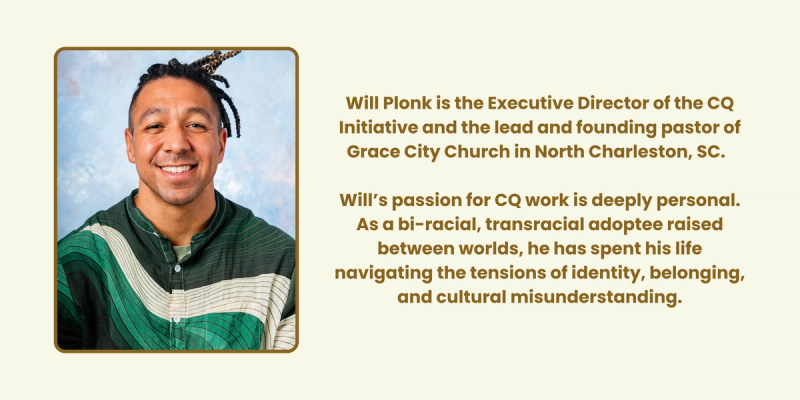
Blog by: Pastor Will Plonk, Executive Director of CQ Initiative